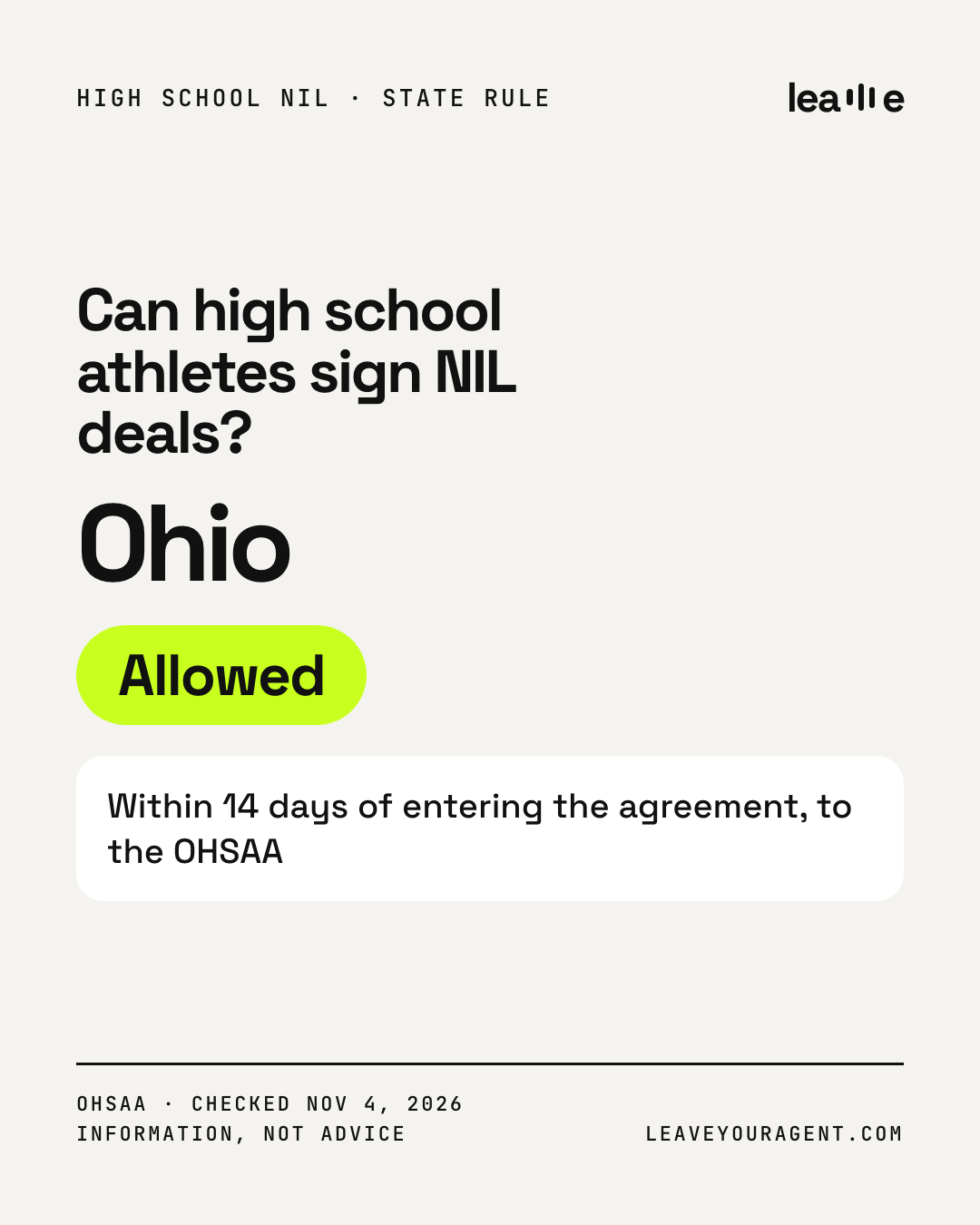
The rule
High school sports in Ohio are governed by the Ohio High School Athletic Association (OHSAA). The rule is OHSAA Bylaw 4-11, Name, Image and Likeness / Personal Branding Rights, approved by member schools in November 2025, with agent wording added in May 2026. Everything on this page is taken from the OHSAA's own text, linked under Sources.
| Question | What the rule says |
|---|---|
| Allowed? | Yes, since November 2025 |
| Who must be told | The OHSAA, through its online portal |
| By when | Within 14 days of entering each agreement |
| School and OHSAA marks | No name, logo, mascot or trademark of the OHSAA, a member school or a school team, and nothing implying their approval |
| Banned categories | Gaming and gambling, alcohol, tobacco, cannabis, banned or illegal substances, adult entertainment, firearms and other weapons, and any other product or service the OHSAA deems inappropriate or distracting |
| Schools, coaches, boosters | A deal may not be provided, procured or facilitated by a school or its agent: collectives, booster clubs, foundations, administrators, coaches |
| Collectives | Strictly prohibited |
| Agents | Allowed, for marketing only, under Ohio's athlete agent law; that agreement is also disclosed within 14 days |
| Penalty | Late or missing disclosure: ineligibility for up to 20% of the sport season, and other penalties under Bylaw 11 |
Correction · Oct 26, 2026
Ten high school pages were re-read against the 2026-27 rule texts.
Next in Ohio
College NIL law in OhioOhio: a statute in force 13 Ohio schools' NIL rules
Akron, Bowling Green, Cincinnati, Cleveland State and 9 more How a deal is reported, level by level
What the rule says
- When and where. No NIL activity during school hours, while travelling to or from an OHSAA event, or during practices, meetings, contests and other official team activities. No displaying a sponsor's product during them.
- Not for performance, not for enrolling. Pay cannot depend on athletic participation, performance or achievement, such as points scored, and a deal cannot be an inducement to attend a particular school.
- Only the student. The agreement may not give money, merchandise or services to the student's school or team.
- Transfers. If a transfer can reasonably be linked to an NIL agreement, the rule presumes the student was recruited, and the OHSAA may suspend participation while it looks.
- How the disclosure works. The student and a parent complete a notarized affirmation and submit it with a full copy of the agreement through the OHSAA's portal.
- College eligibility. The rule makes the student responsible for finding out what a deal does to NCAA, NJCAA or NAIA eligibility.
What sits on top of it
- Your school and district. A school or district can set a stricter policy than the OHSAA. The athletic director is the person who knows it.
- Private and non-member schools. The rule covers OHSAA member schools. A school in another association follows that association's rule.
- College rules later. A deal that is fine in high school can still matter to the NCAA, NJCAA or NAIA. At Division I, third-party deals of $600 or more go to NIL Go. The NIL guide has the college windows.
- Taxes. NIL pay is taxable at any age. NIL taxes in plain words.
- The contract itself. What each clause means.
How Leave fits
In Leave, every deal thread carries a rules summary for the athlete's state, level and age, and a disclosure packet for the school comes with a countdown to the deadline. It is a summary, not a ruling; your school decides. Athletes 13 to 17 use Leave through an account a parent or guardian creates, and are visible to businesses only when the guardian has turned that on and the state allows high school NIL. Leave is software, not an agent. You decide, you send.
An Ohio deal in front of you?
Upload the contract to Leave: what it pays, what it asks of you and its dates, in plain words. Its Rules tab carries the OHSAA's rule, with the day its 14-day disclosure window ends, worked out from the signing date, and a disclosure packet is ready to share. Leave sends it to no one. You decide, you send.
An athlete under 18 uses Leave through an account a parent or guardian creates.



On a computer? Scan with your phone.
leaveyouragent.com/get
Questions about high school NIL in Ohio
Can high school athletes sign NIL deals in Ohio?
Yes. OHSAA member schools approved Bylaw 4-11 in November 2025. A student can be paid for appearances, licensing, social media, endorsements and branding, subject to the nine criteria of Bylaw 4-11-2 and a 14-day disclosure to the OHSAA.
Who do I report an NIL deal to in Ohio?
The OHSAA, within 14 days of entering each agreement, through its online portal. The submission includes a copy of the agreement and a notarized affirmation signed by the student and a parent.
Are NIL collectives allowed in Ohio high school sports?
No. Bylaw 4-11 says collectives are strictly prohibited, and a deal may not be provided, procured or facilitated by a school, booster club, foundation, administrator or coach.
Can an Ohio high school athlete have an agent?
Yes, for marketing only. The bylaw allows an agreement with an athlete agent as defined in Ohio law, solely for marketing the student, and that agreement must be disclosed to the OHSAA within 14 days.
How long does an Ohio high school athlete have to report a new NIL deal?
Within 14 days after entering the agreement. Each agreement is disclosed to the OHSAA, not only the first one (Bylaw 4-11-3). A missing or late disclosure can bring ineligibility for up to 20% of the sport season, plus other penalties under Bylaw 11.
What can't a coach do in an Ohio athlete's NIL deal?
A coach may not provide, procure or facilitate the deal. Bylaw 4-11-2(b) bars any NIL agreement that comes through an OHSAA member school or an agent of the school, and names coaches, administrators, booster clubs, foundations and collectives. Under Bylaw 4-11-6, administrators and coaches must tell the school community that helping arrange an NIL deal to secure a prospective student's enrollment brings Bylaw 11 penalties, including a review of the school's membership.
Which kinds of NIL deals are banned for Ohio high school athletes?
Bylaw 4-11-2(h) bans deals connected to gaming or gambling, alcoholic beverages, tobacco, cannabis, banned or illegal substances, adult entertainment products or services, and firearms or other weapons. It also bans any other product or service the OHSAA deems inappropriate or distracting.
Can an Ohio athlete use the school's name, logo or uniform in an NIL ad?
No. Bylaw 4-11-2(a) bars using the name, logos, mascots, trademarks or other proprietary properties of the OHSAA, a member school or a school team in the deal or its promotions, and bars implying that any of them approves. The OHSAA's student compliance list puts appearing in an NIL endorsement in a school uniform on its "no" side.
Can an Ohio high school athlete be paid for stats, or for picking a school?
No. Pay-for-play and improper recruiting inducements remain prohibited, and a deal may not pay for specific athletic participation, performance or achievement, such as points scored, or be an inducement to attend a particular school (Bylaw 4-11-2(d) and (e)). If a transfer can reasonably be linked to an NIL deal, Bylaw 4-11-5 presumes the student was recruited, and that presumption can be rebutted.
Can an Ohio athlete promote a sponsor at practice or during a game?
No. Bylaw 4-11-2(c) and (f) bar NIL activity during school hours, while traveling to or from an OHSAA event, and during official team activities, including practices, meetings, contests and tournaments, and bar displaying a sponsor's product or advertising for a sponsor during them. The OHSAA's Q&A says a student may still use necessary gear from a sponsor, such as shoes or a bat, in a contest, but the contract cannot require it and the sponsor cannot use images from the contest.
Be your own agent. Leave.