The rule
High school sports in Michigan are governed by the Michigan High School Athletic Association (MHSAA). The rule is MHSAA Handbook Regulation I, Section 11(C), personal branding activities (PBA), with Interpretations 150-154, approved by the Representative Council on January 23, 2026 and announced on January 27, 2026, effective immediately. Everything on this page is taken from the MHSAA's own text, linked under Sources.
| Question | What the rule says |
|---|---|
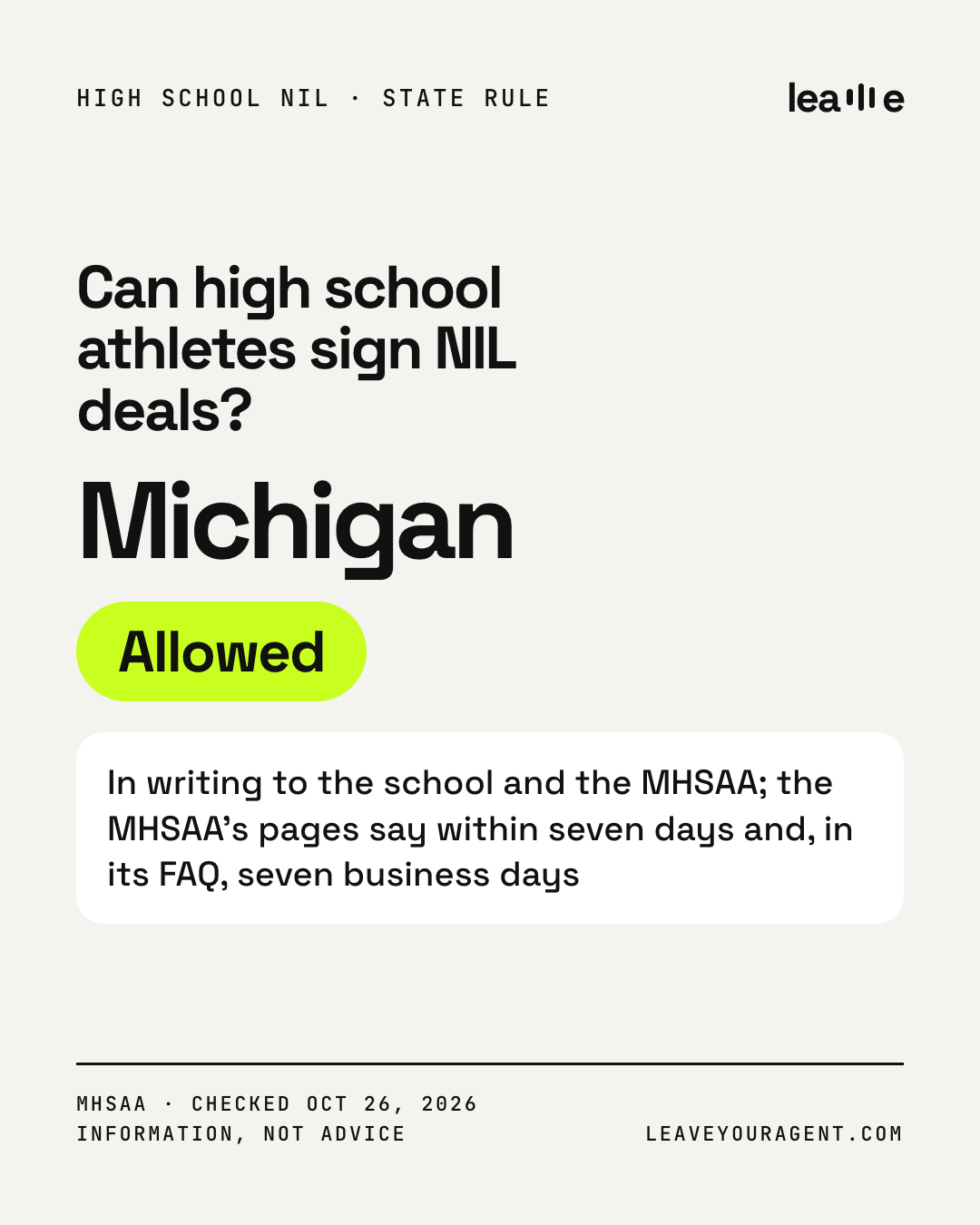
| Allowed? | Yes, since January 2026 |
| Who must be told | The school and the MHSAA, in writing, on the online form at MHSAA.com/NIL, for review and approval |
| By when | The regulation sets no number of days. The MHSAA's NIL page says within seven days; its FAQ says within seven business days |
| School and MHSAA marks | No name, logo, mascot, trademark or other obvious identifier of a member school or the MHSAA, and nothing implying a school's approval. The MHSAA's FAQ adds conference marks and uniforms |
| When and where | Not during school, not at MHSAA events including practice, not on school property, not promoted through school media |
| Banned categories | Gaming or gambling, alcoholic beverages, tobacco, cannabis, banned or illegal substances (including performance enhancing substances), sexually explicit content, firearms or weapons, and any other category the MHSAA determines to be unsuitable or inappropriate |
| Schools, coaches, employees | May not solicit, arrange, negotiate or promote a student's activity |
| Collectives | Prohibited, as is any other group or person tied to a school, along with pay-for-play. Group licensing is on the list of permitted activities |
| Penalty | Ineligible for at least the next 90 scheduled school days after the last violation; a prompt repayment, documented to the MHSAA, can remedy a violation. A school's MHSAA membership can be suspended |
Correction · Oct 26, 2026
Ten high school pages were re-read against the 2026-27 rule texts.
Next in Michigan
College NIL law in MichiganMichigan: a statute in force 7 Michigan schools' NIL rules
Central Michigan, Detroit Mercy, Eastern Michigan, Michigan and 3 more How a deal is reported, level by level
What the rule says
- What is allowed. Camps, clinics and private lessons; social media endorsements and promotions; personal appearances, photo sessions and autograph signings; modelling and advertising; sales of merchandise, sports cards and apparel; and use of the student's name, image or likeness in marketing materials.
- What it has to be based on. The student's individual marketability. The policy bars capitalizing on athletic performances, awards, team participation or the outcome of competition.
- Approval, not only notice. In Pennsylvania and Georgia the school is told. In Michigan the disclosure goes in writing to both the school and the MHSAA, for review and approval, and the MHSAA tells the student and the school in writing of any conflict it finds.
- The window, in the MHSAA's own words. Interpretation 153 sets no number of days. The MHSAA's NIL page (mhsaa.com/students/name-image-likeness) says an opportunity or contract "must be disclosed to the student-athlete's school and the MHSAA within seven (7) days by submitting this required form." The FAQ on that page and in the MHSAA's FAQ sheet (PBA-FAQs.pdf) says "within seven (7) business days of any PBA agreement, contract or opportunity being finalized." Seven calendar days is the earlier of the two.
What sits on top of it
- Your school and district. A school or district can set a stricter policy than the MHSAA. The athletic director is the person who knows it.
- Private and non-member schools. The rule covers MHSAA member schools. A school in another association follows that association's rule.
- College rules later. A deal that is fine in high school can still matter to the NCAA, NJCAA or NAIA. At Division I, third-party deals of $600 or more go to NIL Go. The NIL guide has the college windows.
- Taxes. NIL pay is taxable at any age. NIL taxes in plain words.
- The contract itself. What each clause means.
How Leave fits
In Leave, every deal thread carries a rules summary for the athlete's state, level and age, and a disclosure packet for the school comes with a countdown to the deadline. It is a summary, not a ruling; your school decides. Athletes 13 to 17 use Leave through an account a parent or guardian creates, and are visible to businesses only when the guardian has turned that on and the state allows high school NIL. Leave is software, not an agent. You decide, you send.
A Michigan deal in front of you?
Upload the contract to Leave: what it pays, what it asks of you and its dates, in plain words. Its Rules tab carries the MHSAA's rule, with the day its 7-day disclosure window ends, worked out from the signing date, and a disclosure packet is ready to share. Leave sends it to no one. You decide, you send.
An athlete under 18 uses Leave through an account a parent or guardian creates.


On a computer? Scan with your phone.
leaveyouragent.com/get
Questions about high school NIL in Michigan
Can high school athletes sign NIL deals in Michigan?
Yes. The MHSAA's Representative Council approved the personal branding activities policy on January 23, 2026, and the MHSAA announced it on January 27, effective immediately. Individual deals such as social media endorsements, appearances, autograph signings and merchandise sales are allowed.
Who do I report an NIL deal to in Michigan?
Your school and the MHSAA. Interpretation 153 says any verbal or written opportunity or contract for PBA compensation is disclosed to both in writing, through the online form at MHSAA.com/NIL, for review and approval. The regulation sets no number of days; the MHSAA's NIL page says within seven days, and its FAQ says within seven business days of the agreement, contract or opportunity being finalized.
What NIL deals are not allowed for Michigan high school athletes?
Deals tied to athletic performance, awards or team results; collectives, other groups and people tied to a school, and pay-for-play; anything using school or MHSAA names, logos, mascots or uniforms; activity during school, at MHSAA events or on school property; and products involving gambling, alcohol, tobacco, cannabis, banned or illegal substances, sexually explicit content, or firearms and weapons.
Can my Michigan school or coach help arrange an NIL deal?
No. Schools, including coaches and other employees, are not allowed to solicit, arrange, negotiate or promote a student's personal branding activity.
Be your own agent. Leave.