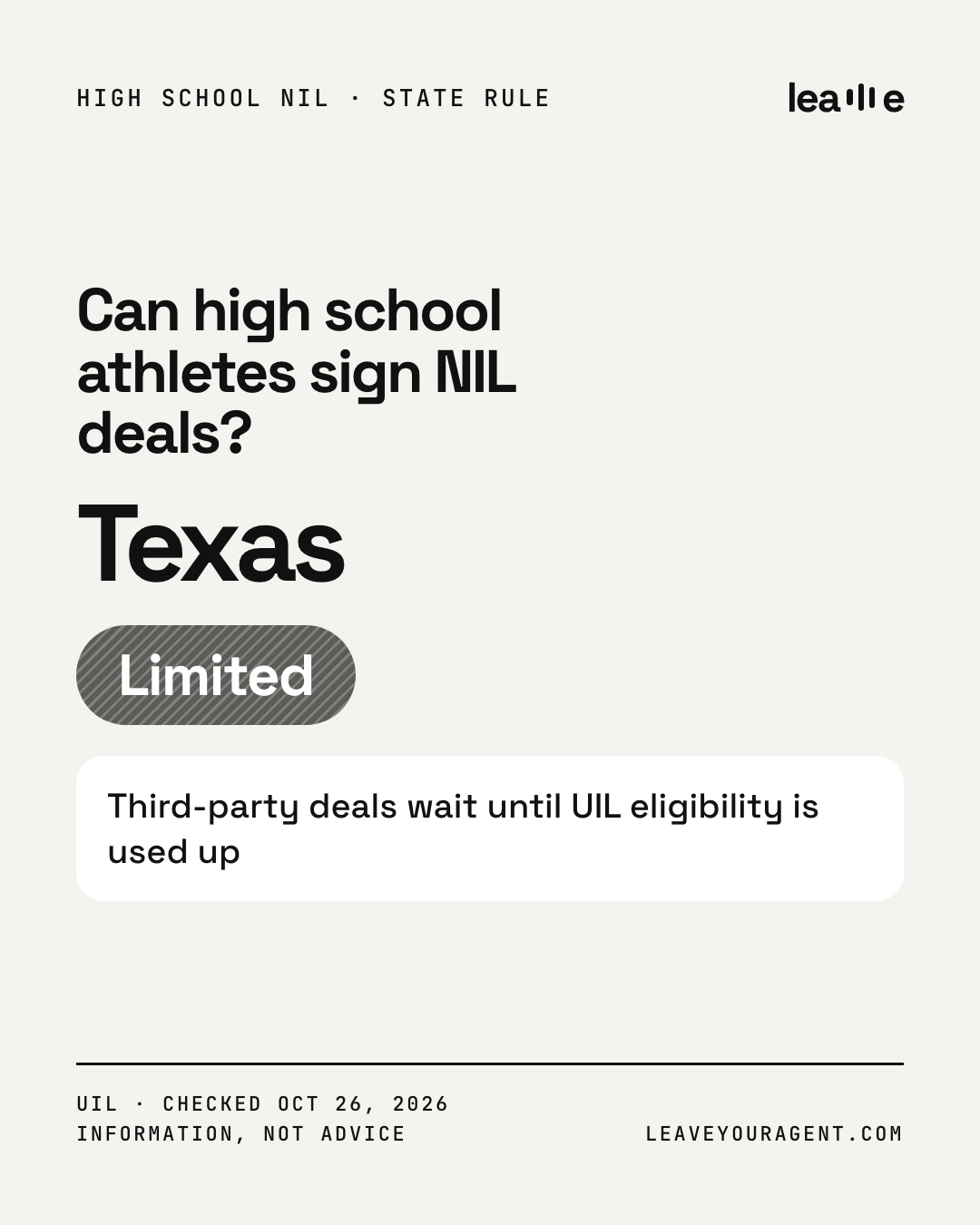
The rule
High school sports in Texas are governed by the University Interscholastic League (UIL). The rule is UIL guidance on House Bill 126 (updated July 15, 2025, reposted for 2026-27) and Section 441 (Amateur Athletic Status), Exception (3), of the 2026-2027 UIL Constitution and Contest Rules, with Texas Education Code 51.9246(k-1), added by House Bill 126. Everything on this page is taken from the UIL's own text, linked under Sources.
| Question | What the rule says |
|---|---|
| Allowed? | Limited. No third-party NIL deals while the student still has UIL eligibility in the sport |
| Age 17 or older | May sign an NIL agreement only with a postsecondary institution |
| Age 16 or younger | May not sign an NIL agreement. Neither may a family member, by blood or marriage, on the student's behalf |
| Deals with brands and local businesses | Only after UIL eligibility in that sport is exhausted, and then under state law and college rules |
| Who must be told | No report is written into the UIL rule |
| School marks | The UIL text sets no marks rule |
| Banned categories | None listed in the UIL rule |
| Professional representation | UIL rules do not prohibit a prospective college athlete from having it for NIL matters |
| The rule behind it | UIL Section 441, Amateur Athletic Status, and its Exception (3) for agreements with a postsecondary institution |
Correction · Oct 26, 2026
Ten high school pages were re-read against the 2026-27 rule texts.
Next in Texas
College NIL law in TexasTexas: a statute in force 15 Texas schools' NIL rules
Baylor, Houston, Prairie View A&M, Rice and 11 more How a deal is reported, level by level
What the rule says
- Why Texas shows up differently on every list. Some lists call Texas "allowed" because a 17-year-old can now sign with a college. Others call it "prohibited" because a brand deal during high school is still out. Both describe the same rule.
- What changed in 2025. House Bill 126 let prospective college athletes aged 17 and older sign NIL agreements with a college or university. The UIL updated its guidance on July 15, 2025. For 2026-27, Section 441's Exception (3) carries the same allowance in the rule itself: a prospective college athlete may sign NIL agreements with a postsecondary institution, in accordance with state law.
- Under 17, in state law. Texas Education Code 51.9246(k-1), added by House Bill 126, bars any individual, company or other organization from entering an NIL arrangement with a prospective student athlete younger than 17, or with a relative by blood or marriage, unless the athlete is enrolled at a college or university.
- What did not change. Section 441, the UIL's amateur rule, still applies to every current UIL athlete, and agreements with anyone other than a college still wait.
What sits on top of it
- Your school and district. A school or district can set a stricter policy than the UIL. The athletic director is the person who knows it.
- Private and non-member schools. The rule covers UIL member schools. A school in another association follows that association's rule.
- College rules later. A deal that is fine in high school can still matter to the NCAA, NJCAA or NAIA. At Division I, third-party deals of $600 or more go to NIL Go. The NIL guide has the college windows.
- Taxes. NIL pay is taxable at any age. NIL taxes in plain words.
- The contract itself. What each clause means.
How Leave fits
In Leave, every deal thread carries a rules summary for the athlete's state, level and age, and for Texas that summary is the UIL rule above. It is a summary, not a ruling; your school decides. Athletes 13 to 17 use Leave through an account a parent or guardian creates, and are visible to businesses only when the guardian has turned that on and the state allows high school NIL. Leave is software, not an agent. You decide, you send.
Texas's rules, in Leave
Leave shows the UIL's rule as it stands, and the college rules for later, on any contract you upload: what it pays, what it asks of you and its dates, in plain words, and a disclosure packet ready to share. Leave sends it to no one. You decide, you send.
An athlete under 18 uses Leave through an account a parent or guardian creates.


On a computer? Scan with your phone.
leaveyouragent.com/get
Questions about high school NIL in Texas
Can high school athletes sign NIL deals in Texas?
Only in a limited way. A student aged 17 or older may sign an NIL agreement with a college or university. Agreements with other businesses cannot be made until the student has exhausted UIL eligibility in that sport, and students 16 or younger cannot sign an NIL agreement.
Can a Texas high school athlete do a paid post for a local business?
Not while they still have UIL eligibility in that sport. Under the UIL's guidance, NIL agreements with entities other than postsecondary institutions wait until that eligibility is exhausted.
Can a parent sign an NIL deal for a Texas athlete who is under 17?
No. The UIL's guidance says family members, by blood or marriage, of athletes aged 16 or younger cannot sign NIL agreements either.
Can a Texas high school athlete have an agent?
The UIL says its rules do not prohibit a prospective college athlete from obtaining professional representation for NIL matters.
Be your own agent. Leave.